Questionnaire
Native questionnaire composition, package imports, and editable Swift source.
Preview
Use it
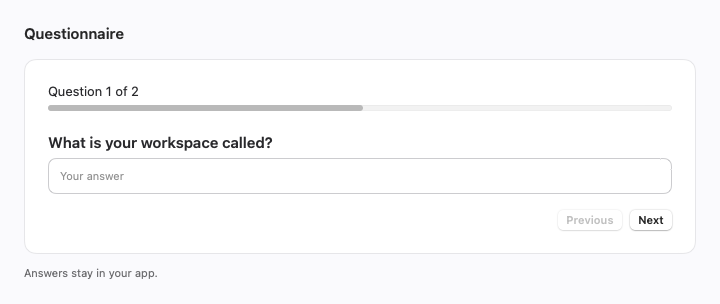
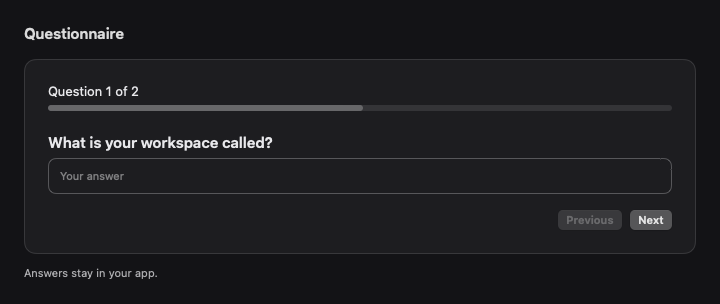
Import SwiftCN to use CNQuestionnaire directly. This complete example also runs in the native component gallery.
import SwiftUI
import SwiftCN

struct QuestionnaireExample: View {
    @State private var answers: [String: CNAnswer] = [:]
    @State private var questionIndex = 0
    @State private var submitted = false

    var body: some View {
        VStack(alignment: .leading, spacing: 12) {
            CNQuestionnaire([
                CNQuestion("name", title: "What is your workspace called?"),
                CNQuestion("plan", title: "Choose a plan", kind: .single([
                    CNOption("personal", title: "Personal"), CNOption("team", title: "Team")
                ]))
            ], answers: $answers, activeIndex: $questionIndex) { _ in submitted = true }
            Text(submitted ? "Submitted" : "Answers stay in your app.").tw("text-sm text-mutedForeground")

        }
    }
}
Native behavior
The host owns ordered questions, answers, active index, cancellation, and submission. Required, type, single-choice, and available-option validation runs before submission. IDs must be unique. Branching, transport, and persistence belong to the host.
Style and compose
Visual recipes use .tw classes. Append classes: to override a recipe locally, or change the recipe in TWGlobalRules.named for your subtree. Native layout and interaction modifiers remain SwiftUI APIs. For control colors, append cn-tint-[primary], another theme token, or an interpolated Color.
Motion recipes are editable too: control-motion uses a 150 ms smooth response, disclosure-motion uses a 250 ms spring, and feedback-motion uses a 200 ms smooth response. Set a recipe to animate-none in your global rules to turn it off. Presets respect Reduce Motion. Static components stay still; native scrolling, drag tracking, and platform presentation keep their own gestures.
Action groups and card, dialog, and questionnaire footers stack when their content does not fit. The native layout preserves the same child controls during this change.
View builders preserve native child content. Native Button roles, labels, keyboard shortcuts, submit actions, and presentation modifiers still work. A string recipe does not replace a native control API or a typed chart mark.
Own the source
Copy the complete file below into your app alongside import SwiftCN. The file contains related composable parts from the same family. Its dependencies use public package APIs, so copied and imported components can coexist.
To own the styling engine too, download the complete source bundle. It contains every component, the .tw engine, its recipes, and the MIT license. Keep those files in one module and remove import SwiftCN from the usage example.
import SwiftUI
import SwiftCN
import Accessibility

public struct CNQuestion: Identifiable, Equatable, Sendable {
    public enum Kind: Equatable, Sendable {
        case text
        case single([CNOption<String>])
        case multiple([CNOption<String>])
    }
    public let id: String
    public var title: String
    public var description: String?
    public var kind: Kind
    public var isRequired: Bool
    public init(_ id: String, title: String, description: String? = nil, kind: Kind = .text, isRequired: Bool = true) {
        self.id = id; self.title = title; self.description = description; self.kind = kind; self.isRequired = isRequired
    }
}
public enum CNAnswer: Equatable, Sendable {
    case text(String)
    case choices(Set<String>)
    public var textValue: String? { if case .text(let value) = self { return value }; return nil }
    public var choiceValues: Set<String>? { if case .choices(let value) = self { return value }; return nil }
}
public enum CNQuestionnaireValidation {
    /// Native controls can write the displayed value during focus without a user edit.
    public static func changesText(_ answer: CNAnswer?, to value: String) -> Bool { (answer?.textValue ?? "") != value }

    public static func error(for question: CNQuestion, answer: CNAnswer?) -> String? {
        switch (question.kind, answer) {
        case (.text, .text(let text)):
            return question.isRequired && text.trimmingCharacters(in: .whitespacesAndNewlines).isEmpty ? "Enter an answer to continue." : nil
        case (.single(let options), .choices(let ids)), (.multiple(let options), .choices(let ids)):
            let allowed = Set(options.filter { !$0.isDisabled }.map(\.id))
            guard ids.isSubset(of: allowed) else { return "Choose an available answer." }
            if case .single = question.kind, ids.count > 1 { return "Choose one answer." }
            return question.isRequired && ids.isEmpty ? "Choose an answer to continue." : nil
        case (_, nil): return question.isRequired ? "Answer this question to continue." : nil
        default: return "The answer does not match this question."
        }
    }
    /// A deterministic navigation decision lets hosts test validation without synthesizing UI events.
    public static func next(questions: [CNQuestion], answers: [String: CNAnswer], activeIndex: Int) -> CNQuestionnaireStep {
        guard !questions.isEmpty else { return .empty }
        let index = min(max(0, activeIndex), questions.count - 1)
        if let message = error(for: questions[index], answer: answers[questions[index].id]) {
            return .invalid(index: index, message: message)
        }
        if index < questions.count - 1 { return .advance(index: index + 1) }
        if let invalid = questions.firstIndex(where: { error(for: $0, answer: answers[$0.id]) != nil }) {
            return .invalid(index: invalid, message: error(for: questions[invalid], answer: answers[questions[invalid].id])!)
        }
        let ids = Set(questions.map(\.id))
        return .submit(answers.filter { ids.contains($0.key) })
    }

}

public enum CNQuestionnaireStep: Equatable, Sendable {
    case empty
    case invalid(index: Int, message: String)
    case advance(index: Int)
    case submit([String: CNAnswer])
}

/// The host owns questions, answers, persistence, cancellation, and submission.
/// This view owns only validation feedback; branching and transport stay in application code.
public struct CNQuestionnaire: View {
    private let questions: [CNQuestion]
    @Binding private var answers: [String: CNAnswer]
    @Binding private var activeIndex: Int
    private let classes: TWClasses
    private let onSubmit: ([String: CNAnswer]) -> Void
    private let onCancel: (() -> Void)?
    @State private var validationError: String?
    @State private var errorQuestionID: String?
    @FocusState private var textFocused: Bool
    public init(_ questions: [CNQuestion], answers: Binding<[String: CNAnswer]>, activeIndex: Binding<Int>,
                classes: TWClasses = "", onCancel: (() -> Void)? = nil, onSubmit: @escaping ([String: CNAnswer]) -> Void) {
        precondition(Set(questions.map(\.id)).count == questions.count, "Question IDs must be unique.")
        self.questions = questions; _answers = answers; _activeIndex = activeIndex
        self.classes = classes; self.onCancel = onCancel; self.onSubmit = onSubmit
    }
    private var index: Int { min(max(0, activeIndex), max(0, questions.count - 1)) }
    public var body: some View {
        VStack(alignment: .leading, spacing: 16) {
            if !questions.isEmpty {
                let question = questions[index]
                CNProgress("Question \(index + 1) of \(questions.count)", value: Double(index + 1), total: Double(questions.count))
                CNField(isInvalid: validationError != nil && errorQuestionID == question.id) {
                    Text(question.title).tw("text-lg font-semibold").accessibilityAddTraits(.isHeader)
                    if let description = question.description { Text(description).tw("text-sm text-mutedForeground") }
                    answerControl(question).id(question.id)
                    if let validationError, errorQuestionID == question.id { Text(validationError).tw("field-error") }
                }
                CNAdaptiveActionLayout(spacing: 8, verticalAlignment: .trailing) {
                    CNButton("Previous", variant: .outline, action: { activeIndex = index - 1 }).disabled(index == 0)
                    if let onCancel { CNButton("Cancel", role: .cancel, variant: .ghost, action: onCancel) }
                    if !question.isRequired { CNButton("Skip", variant: .ghost, action: { answers[question.id] = nil; continueFromCurrent() }) }
                    CNButton(index == questions.count - 1 ? "Submit" : "Next", action: continueFromCurrent).keyboardShortcut(.defaultAction)
                }.frame(maxWidth: .infinity, alignment: .trailing)
            } else {
                Text("No questions").tw("text-sm text-mutedForeground")
            }
        }.tw(cn("questionnaire", classes))
            .onChange(of: questions, initial: true) { _, _ in
                if activeIndex != index { activeIndex = index }
                validationError = nil
            }
    }
    @ViewBuilder private func answerControl(_ question: CNQuestion) -> some View {
        switch question.kind {
        case .text:
            CNInput("Your answer", text: Binding(get: {
                if case .text(let value) = answers[question.id] { return value }; return ""
            }, set: { value in
                guard CNQuestionnaireValidation.changesText(answers[question.id], to: value) else { return }
                answers[question.id] = .text(value); validationError = nil
            }), focus: $textFocused)
                .accessibilityLabel(question.title)
                .onSubmit(continueFromCurrent)
        case .single(let options):
            CNRadioGroup("Your answer", options: options, selection: Binding<String?>(get: {
                guard case .choices(let ids) = answers[question.id] else { return nil }
                return options.first { ids.contains($0.id) }?.id
            }, set: { value in
                let current = options.first { answers[question.id]?.choiceValues?.contains($0.id) ?? false }?.id
                guard value != current else { return }
                answers[question.id] = value.map { .choices([$0]) }; validationError = nil
            })).accessibilityLabel(question.title)
        case .multiple(let options):
            VStack(alignment: .leading, spacing: 8) {
                ForEach(options) { option in
                    CNCheckbox(isOn: Binding(get: {
                        if case .choices(let ids) = answers[question.id] { return ids.contains(option.id) }; return false
                    }, set: { isOn in
                        var ids: Set<String> = []
                        if case .choices(let stored) = answers[question.id] { ids = stored }
                        if isOn {
                            ids.insert(option.id)
                        } else { ids.remove(option.id) }
                        answers[question.id] = .choices(ids); validationError = nil
                    })) { Text(option.title) }.disabled(option.isDisabled)
                }
            }
        }
    }
    private func continueFromCurrent() {
        let step = CNQuestionnaireValidation.next(questions: questions, answers: answers, activeIndex: index)
        switch step {
        case .empty: break
        case .advance(let next): validationError = nil; activeIndex = next
        case .submit(let validated): validationError = nil; onSubmit(validated)
        case .invalid(let invalid, let message):
            activeIndex = invalid; errorQuestionID = questions[invalid].id; validationError = message
            AccessibilityNotification.Announcement(message).post()
            if case .text = questions[invalid].kind { textFocused = true }
        }
    }
}