
Carousel
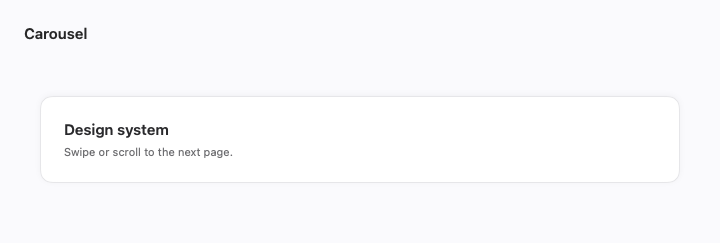
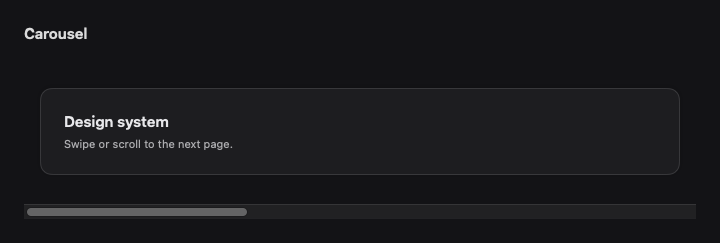
Native carousel composition, package imports, and editable Swift source.
Preview
Use it
Import SwiftCN to use CNCarousel directly. This complete example also runs in the native component gallery.
import SwiftUI
import SwiftCN

struct CarouselExample: View {
    @State private var optionalSelection: String? = nil
    private let options = [CNOption("design", title: "Design system"), CNOption("mobile", title: "Mobile app"), CNOption("archive", title: "Archived", isDisabled: true)]

    var body: some View {
        VStack(alignment: .leading, spacing: 12) {
            CNCarousel(options, selection: $optionalSelection, classes: "h-[160]") { option in
                CNCard {
                    CNCardHeader("pb-6") {
                        CNCardTitle { Text(option.title) }
                        CNCardDescription("Swipe or scroll to the next page.")
                    }
                }.tw("p-4")
            }

        }
    }
}
Native behavior
Uses native horizontal scroll paging and stable IDs. Deleting a selected item moves selection to the first remaining page. VoiceOver provides next and previous page actions. Size the viewport with classes.
Style and compose
Visual recipes use .tw classes. Append classes: to override a recipe locally, or change the recipe in TWGlobalRules.named for your subtree. Native layout and interaction modifiers remain SwiftUI APIs. For control colors, append cn-tint-[primary], another theme token, or an interpolated Color.
Motion recipes are editable too: control-motion uses a 150 ms smooth response, disclosure-motion uses a 250 ms spring, and feedback-motion uses a 200 ms smooth response. Set a recipe to animate-none in your global rules to turn it off. Presets respect Reduce Motion. Static components stay still; native scrolling, drag tracking, and platform presentation keep their own gestures.
Action groups and card, dialog, and questionnaire footers stack when their content does not fit. The native layout preserves the same child controls during this change.
View builders preserve native child content. Native Button roles, labels, keyboard shortcuts, submit actions, and presentation modifiers still work. A string recipe does not replace a native control API or a typed chart mark.
Own the source
Copy the complete file below into your app alongside import SwiftCN. The file contains related composable parts from the same family. Its dependencies use public package APIs, so copied and imported components can coexist.
To own the styling engine too, download the complete source bundle. It contains every component, the .tw engine, its recipes, and the MIT license. Keep those files in one module and remove import SwiftCN from the usage example.
import SwiftUI
import SwiftCN

public struct CNScrollArea<Content: View>: View {
    private let axes: Axis.Set
    private let indicators: Bool
    private let classes: TWClasses
    private let content: Content
    public init(_ axes: Axis.Set = .vertical, showsIndicators: Bool = true, classes: TWClasses = "", @ViewBuilder content: () -> Content) {
        self.axes = axes; indicators = showsIndicators; self.classes = classes; self.content = content()
    }
    public var body: some View { ScrollView(axes, showsIndicators: indicators) { content }.tw(cn("scroll-area", classes)) }
}
/// Stable native scroll targets preserve reading position when history is prepended.
/// The host owns following policy. Bind isAtBottom to observe proximity to the end.
public struct CNMessageScroller<Data: RandomAccessCollection, Content: View>: View where Data.Element: Identifiable {
    private let data: Data
    private let followNewMessages: Bool
    private let scrollRevision: Int
    private let position: Binding<Data.Element.ID?>?
    private let bottomState: Binding<Bool>?
    private let classes: TWClasses
    private let content: (Data.Element) -> Content
    @State private var localPosition: Data.Element.ID?
    @State private var bottomID = UUID()
    @State private var readingAnchor = CNMessageReadingAnchor<Data.Element.ID>()
    public init(_ data: Data, followNewMessages: Bool = false, scrollRevision: Int = 0,
                position: Binding<Data.Element.ID?>? = nil, isAtBottom: Binding<Bool>? = nil,
                classes: TWClasses = "", @ViewBuilder content: @escaping (Data.Element) -> Content) {
        self.data = data; self.followNewMessages = followNewMessages; self.scrollRevision = scrollRevision
        self.position = position; bottomState = isAtBottom; self.classes = classes; self.content = content
    }
    public var body: some View {
        GeometryReader { viewport in
            let viewportHeight = viewport.size.height
            ScrollViewReader { proxy in
                ScrollView {
                    LazyVStack(alignment: .leading, spacing: 8) {
                        ForEach(data) { item in
                            content(item).id(item.id).background {
                                if !followNewMessages && item.id == (position?.wrappedValue ?? localPosition) {
                                    Color.clear.onGeometryChange(for: CNMessageReadingFrame.self, of: {
                                        let frame = $0.frame(in: .scrollView(axis: .vertical))
                                        return CNMessageReadingFrame(minY: frame.minY, height: frame.height)
                                    }) { frame in
                                        guard readingAnchor.frame == nil || readingAnchor.firstID == data.first?.id else { return }
                                        readingAnchor.firstID = data.first?.id
                                        readingAnchor.targetID = item.id
                                        readingAnchor.frame = frame
                                    }
                                }
                            }
                        }
                    }.scrollTargetLayout()
                    Color.clear.frame(height: 1)
                        .id(bottomID)
                        .onGeometryChange(for: CNMessageEndGeometry.self, of: {
                            CNMessageEndGeometry(bottom: $0.frame(in: .scrollView(axis: .vertical)).maxY,
                                                 height: $0.bounds(of: .scrollView(axis: .vertical))?.height ?? viewportHeight)
                        }) { end in
                            // Newer systems observe the native scroll geometry instead of this sentinel.
                            if #available(iOS 18, macOS 15, *) { return }
                            updateEnd(CNMessageEndState(bottom: end.bottom, height: end.height), proxy: proxy)
                        }
                }
                .modifier(CNMessageEndObserver { updateEnd($0, proxy: proxy) })
                .scrollPosition(id: position ?? $localPosition, anchor: followNewMessages ? .bottom : .top)
                .defaultScrollAnchor(followNewMessages ? .bottom : (position?.wrappedValue == nil ? .top : nil))
                .tw("scroll-area")
                .onAppear {
                    if followNewMessages { scrollToLatest(proxy) }
                    else { restoreReadingTarget(proxy, height: viewportHeight) }
                    readingAnchor.hasAppeared = true
                }
                .task(id: followNewMessages) {
                    // Older SwiftUI versions register scroll targets after appearance.
                    await Task.yield()
                    guard !Task.isCancelled else { return }
                    if followNewMessages { scrollToLatest(proxy) }
                    else if readingAnchor.initialRestorationPending { restoreReadingTarget(proxy, height: viewportHeight) }
                    readingAnchor.initialRestorationPending = false
                }
                .onChange(of: data.first?.id) { _, _ in
                    if followNewMessages { scrollToLatest(proxy) }
                    else { restoreReadingTarget(proxy, height: viewportHeight) }
                    readingAnchor.firstID = data.first?.id
                }
                .onChange(of: scrollRevision) { _, _ in if followNewMessages { scrollToLatest(proxy) } }
                .onChange(of: data.last?.id) { _, _ in if followNewMessages { scrollToLatest(proxy) } }
                .onChange(of: viewport.size) { _, _ in if followNewMessages { scrollToLatest(proxy) } }
            }
        }.tw(classes)
    }
    private func updateEnd(_ end: CNMessageEndState, proxy: ScrollViewProxy) {
        if let bottomState, bottomState.wrappedValue != end.isAtBottom { bottomState.wrappedValue = end.isAtBottom }
        if followNewMessages && end.needsFollowing { scrollToLatest(proxy) }
    }
    private func restoreReadingTarget(_ proxy: ScrollViewProxy, height: CGFloat) {
        guard let target = position?.wrappedValue ?? localPosition else { return }
        let frame = readingAnchor.hasAppeared && !readingAnchor.initialRestorationPending && readingAnchor.targetID == target ? readingAnchor.frame : nil
        let available = height - (frame?.height ?? 0)
        let anchor = UnitPoint(x: 0.5, y: available > 1 ? (frame?.minY ?? 0) / available : 0)
        var transaction = Transaction(); transaction.disablesAnimations = true
        withTransaction(transaction) { proxy.scrollTo(target, anchor: anchor) }
    }
    private func scrollToLatest(_ proxy: ScrollViewProxy) {
        guard !data.isEmpty else { return }
        // Streaming and keyboard layout changes must not enqueue competing animations.
        var transaction = Transaction(); transaction.disablesAnimations = true
        withTransaction(transaction) { proxy.scrollTo(bottomID, anchor: .bottom) }
    }
}
// One visible target stores its pixel offset without invalidating body during scrolling.
@MainActor private final class CNMessageReadingAnchor<ID> {
    var hasAppeared = false
    var initialRestorationPending = true
    var firstID: ID?
    var targetID: ID?
    var frame: CNMessageReadingFrame?
}
// Only these two values are needed. Avoid exposing CGRect's SDK conformance in the opaque body type.
private struct CNMessageReadingFrame: Equatable {
    let minY: CGFloat
    let height: CGFloat
}
private struct CNMessageEndGeometry: Equatable {
    let bottom: CGFloat
    let height: CGFloat
}
// Native geometry emits only boundary changes, rather than every scrolling pixel.
private struct CNMessageEndState: Equatable {
    let isAtBottom: Bool
    let needsFollowing: Bool
    init(bottom: CGFloat, height: CGFloat) {
        isAtBottom = bottom <= height + 24 && bottom >= 0
        needsFollowing = bottom.isFinite && bottom > height + 1
    }
}
private struct CNMessageEndObserver: ViewModifier {
    let update: (CNMessageEndState) -> Void
    func body(content: Content) -> some View {
        if #available(iOS 18, macOS 15, *) {
            content.onScrollGeometryChange(for: CNMessageEndState.self, of: { geometry in
                CNMessageEndState(bottom: geometry.contentSize.height + geometry.contentInsets.bottom - geometry.contentOffset.y,
                                  height: geometry.containerSize.height)
            }) { _, value in update(value) }
        } else {
            content
        }
    }
}
/// Native scroll paging with a binding to the stable item ID. Size the viewport with classes.
public struct CNCarousel<Data: RandomAccessCollection, Content: View>: View where Data.Element: Identifiable {
    private let data: Data
    @Binding private var selection: Data.Element.ID?
    @Environment(\.accessibilityReduceMotion) private var reduceMotion
    private let classes: TWClasses
    private let content: (Data.Element) -> Content
    public init(_ data: Data, selection: Binding<Data.Element.ID?>, classes: TWClasses = "",
                @ViewBuilder content: @escaping (Data.Element) -> Content) {
        self.data = data; _selection = selection; self.classes = classes; self.content = content
    }
    public var body: some View {
        ScrollView(.horizontal) {
            LazyHStack(spacing: 0) {
                ForEach(data) { item in content(item).containerRelativeFrame(.horizontal).id(item.id) }
            }.scrollTargetLayout()
        }.scrollTargetBehavior(.paging).scrollPosition(id: $selection).tw(cn("carousel", classes))
            .onChange(of: data.map(\.id), initial: true) { _, ids in
                if let selection, !ids.contains(selection) { self.selection = ids.first }
            }
            .accessibilityAction(named: Text("Next page")) { move(1) }
            .accessibilityAction(named: Text("Previous page")) { move(-1) }
    }
    private func move(_ delta: Int) {
        let ids = data.map(\.id)
        guard !ids.isEmpty else { return }
        let index = selection.flatMap { ids.firstIndex(of: $0) } ?? 0
        withAnimation(reduceMotion ? nil : .smooth(duration: 0.25)) {
            selection = ids[min(ids.count - 1, max(0, index + delta))]
        }
    }
}