Dialog
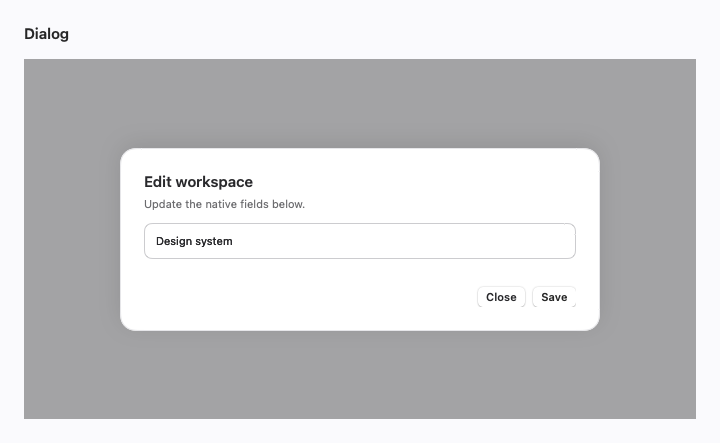
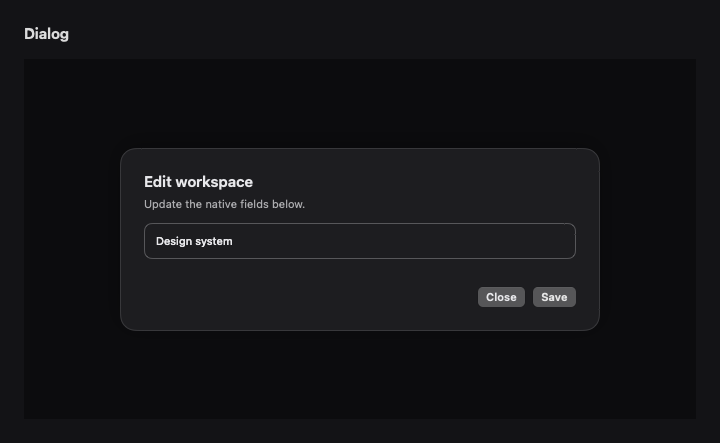
Native dialog composition, package imports, and editable Swift source.
Preview
Use it
Import SwiftCN to use CNDialog directly. This complete example also runs in the native component gallery.
import SwiftUI
import SwiftCN

// At your screen or window root, install .cnPresentationHost().
struct DialogExample: View {
    @State private var text = "Design system"
    @State private var presented = false

    init(initialPresented: Bool = false) { _presented = State(initialValue: initialPresented) }

    var body: some View {
        VStack(alignment: .leading, spacing: 12) {
            CNDialog(isPresented: $presented) {
                CNDialogHeader { CNDialogTitle("Edit workspace"); CNDialogDescription("Update the native fields below.") }
                CNInput("Name", text: $text)
                CNDialogFooter { CNDialogClose(); CNButton("Save", action: { presented = false }) }
            } label: { Text("Edit workspace") }

        }
    }
}
Native behavior
A centered custom SwiftUI panel uses native buttons, editors, and focus. Install .cnPresentationHost() once at the screen or window root, outside scrolling containers. Compose headers, fields, footer actions, and CNDialogClose. Backdrop activation, Escape, and the accessibility escape action dismiss it. The mounted panel preserves drafts through interrupted motion. Without a host, presentation falls back to a native sheet. Override contentClasses or presentation-dialog, presentation-scrim, and presentation-motion in your global rules.
Style and compose
Visual recipes use .tw classes. Append classes: to override a recipe locally, or change the recipe in TWGlobalRules.named for your subtree. Native layout and interaction modifiers remain SwiftUI APIs. For control colors, append cn-tint-[primary], another theme token, or an interpolated Color.
Motion recipes are editable too: control-motion uses a 150 ms smooth response, disclosure-motion uses a 250 ms spring, and feedback-motion uses a 200 ms smooth response. Set a recipe to animate-none in your global rules to turn it off. Presets respect Reduce Motion. Static components stay still; native scrolling, drag tracking, and platform presentation keep their own gestures.
Action groups and card, dialog, and questionnaire footers stack when their content does not fit. The native layout preserves the same child controls during this change.
View builders preserve native child content. Native Button roles, labels, keyboard shortcuts, submit actions, and presentation modifiers still work. A string recipe does not replace a native control API or a typed chart mark.
Own the source
Copy the complete file below into your app alongside import SwiftCN. The file contains related composable parts from the same family. Its dependencies use public package APIs, so copied and imported components can coexist.
To own the styling engine too, download the complete source bundle. It contains every component, the .tw engine, its recipes, and the MIT license. Keep those files in one module and remove import SwiftCN from the usage example.
import SwiftUI
import SwiftCN

/// Install once at a window or screen root, outside scrolling and native containers.
/// Panels inherit the theme and rules without creating a second native window.
/// Place shared environment dependencies above the host; inject presenter-local dependencies inside panel content.
public struct CNPresentationHost<Content: View>: View {
    private let content: Content
    @State private var active: [UUID] = []
    @State private var lastPresented: UUID?
    @FocusState private var focus: CNPresentationFocus?
    @Environment(\.layoutDirection) private var direction
    public init(@ViewBuilder content: () -> Content) { self.content = content() }
    public var body: some View {
        content.environment(\.cnPresentationHosted, true)
            .environment(\.cnPresentationFocus, $focus)
            .disabled(!active.isEmpty).accessibilityHidden(!active.isEmpty)
            .overlayPreferenceValue(CNPresentationRequests.self) { requests in
                // Measure system insets before expanding the overlay; placement applies them once.
                GeometryReader { safeArea in
                    GeometryReader { geometry in
                        ZStack {
                            ForEach(requests) { request in
                                let regions = geometry.cnPlacementRegions(layoutDirection: direction, insets: safeArea.safeAreaInsets)
                                let placement = CNPlacementRegions.preferred(in: regions,
                                    near: request.kind.preferredPoint(in: geometry.size, direction: direction))
                                CNPresentationPanel(request: request, focus: $focus, size: geometry.size, placement: placement)
                                    .transformEnvironment(\.self) { values in
                                        // Preserve public appearance without importing private focus dispatch state.
                                        values.cnPresentationAppearance(from: request.environment)
                                    }
                            }
                        }.frame(width: geometry.size.width, height: geometry.size.height)
                            .onChange(of: requests.filter { $0.presentation.wrappedValue }.map(\.id)) { old, new in
                                guard let newest = new.first(where: { !old.contains($0) }) else { return }
                                for request in requests where request.id != newest && request.presentation.wrappedValue {
                                    request.presentation.wrappedValue = false
                                }
                            }
                    }.ignoresSafeArea()
                }
            }
            .onPreferenceChange(CNPresentationPresence.self) { active = $0 }
            .task(id: active) {
                let target = active.last.map { CNPresentationFocus.panel($0) }
                    ?? lastPresented.map { CNPresentationFocus.trigger($0) }
                guard let target else { return }
                if let presented = active.last { lastPresented = presented }
                // One owner coordinates panel focus and restoration after the enabled scope updates.
                focus = nil
                await Task.yield()
                guard !Task.isCancelled else { return }
                focus = target
                if active.isEmpty { lastPresented = nil }
            }
            .transformPreference(CNPresentationRequests.self) { $0 = [] }
            .transformPreference(CNPresentationPresence.self) { $0 = [] }
    }
}

extension View {
    public func cnPresentationHost() -> some View { CNPresentationHost { self } }
}

private enum CNPresentationKind {
    case dialog, sheet(Edge)
    func preferredPoint(in size: CGSize, direction: LayoutDirection) -> CGPoint {
        switch self {
        case .dialog: CGPoint(x: size.width / 2, y: size.height / 2)
        case .sheet(.top): CGPoint(x: size.width / 2, y: 0)
        case .sheet(.bottom): CGPoint(x: size.width / 2, y: size.height)
        case .sheet(let edge): CGPoint(x: (edge == .leading) == (direction == .leftToRight) ? 0 : size.width, y: size.height / 2)
        }
    }
    var recipe: TWClasses {
        switch self {
        case .dialog: "presentation-dialog"
        case .sheet: "presentation-sheet"
        }
    }
    var alignment: Alignment {
        switch self {
        case .dialog: .center
        case .sheet(.bottom): .bottom
        case .sheet(.top): .top
        case .sheet(.leading): .leading
        case .sheet: .trailing
        }
    }
}

private enum CNPresentationFocus: Hashable { case trigger(UUID), panel(UUID) }
private struct CNPresentationFocusKey: EnvironmentKey {
    static var defaultValue: FocusState<CNPresentationFocus?>.Binding? { nil }
}
extension EnvironmentValues {
    fileprivate var cnPresentationFocus: FocusState<CNPresentationFocus?>.Binding? {
        get { self[CNPresentationFocusKey.self] }
        set { self[CNPresentationFocusKey.self] = newValue }
    }
}

private struct CNPresentationTrigger<Label: View, Popup: View>: View {
    @Binding var isPresented: Bool
    let kind: CNPresentationKind
    let classes: TWClasses
    let contentClasses: TWClasses
    @ViewBuilder let content: () -> Popup
    @ViewBuilder let label: () -> Label
    @Environment(\.cnPresentationHosted) private var hosted
    @Environment(\.self) private var environment
    @Environment(\.isEnabled) private var enabled
    @State private var id = UUID()
    @State private var restoreFocus = false
    @Environment(\.cnPresentationFocus) private var hostedFocus
    @FocusState private var localFocus: CNPresentationFocus?
    private var triggerFocus: FocusState<CNPresentationFocus?>.Binding { hostedFocus ?? $localFocus }
    private var triggerFocused: Bool { triggerFocus.wrappedValue == .trigger(id) }
    var body: some View {
        let trigger = Button(action: { isPresented = true }, label: label)
            .focusable().focusEffectDisabled().focused(triggerFocus, equals: .trigger(id))
            .buttonStyle(.tw(cn("button-outline", classes), state: .init(isFocused: triggerFocused)))
            .onKeyPress(keys: [.return, .space]) { _ in isPresented = true; return .handled }
            .onChange(of: isPresented, initial: true) { _, open in
                if open && !hosted { restoreFocus = true; triggerFocus.wrappedValue = nil }
            }
            .task(id: enabled && restoreFocus && !isPresented) {
                guard !hosted, enabled && restoreFocus && !isPresented else { return }
                // Let the closing panel release focus and the trigger rejoin the enabled focus scope.
                await Task.yield()
                guard !Task.isCancelled, !hosted, enabled, restoreFocus, !isPresented else { return }
                triggerFocus.wrappedValue = .trigger(id); restoreFocus = false
            }
        if hosted {
            trigger.preference(key: CNPresentationRequests.self, value: [
                CNPresentationRequest(id: id, kind: kind, presentation: $isPresented, classes: contentClasses,
                                      environment: environment, content: AnyView(content()))
            ])
            .preference(key: CNPresentationPresence.self, value: isPresented ? [id] : [])
            .onDisappear { isPresented = false }
        } else {
            trigger.sheet(isPresented: $isPresented) {
                CNDialogContent(contentClasses, content: content)
            }
        }
    }
}

private struct CNPresentationRequest: Identifiable {
    let id: UUID
    let kind: CNPresentationKind
    let presentation: Binding<Bool>
    let classes: TWClasses
    let environment: EnvironmentValues
    let content: AnyView
}
private struct CNPresentationRequests: PreferenceKey {
    static var defaultValue: [CNPresentationRequest] { [] }
    static func reduce(value: inout [CNPresentationRequest], nextValue: () -> [CNPresentationRequest]) { value += nextValue() }
}
private struct CNPresentationPresence: PreferenceKey {
    static let defaultValue: [UUID] = []
    static func reduce(value: inout [UUID], nextValue: () -> [UUID]) { value += nextValue() }
}
private struct CNPresentationHostedKey: EnvironmentKey { static let defaultValue = false }
extension EnvironmentValues {
    fileprivate var cnPresentationHosted: Bool {
        get { self[CNPresentationHostedKey.self] }
        set { self[CNPresentationHostedKey.self] = newValue }
    }
}

private struct CNPresentationPanel: View {
    let request: CNPresentationRequest
    let focus: FocusState<CNPresentationFocus?>.Binding
    let size: CGSize
    let placement: CGRect
    @State private var mounted = false
    @State private var contentHeight: CGFloat = 240
    @Environment(\.layoutDirection) private var direction
    private var open: Bool { request.presentation.wrappedValue }
    private func close() { request.presentation.wrappedValue = false }
    private var hiddenOffset: CGSize {
        switch request.kind {
        case .dialog: .zero
        case .sheet(.bottom): CGSize(width: 0, height: size.height)
        case .sheet(.top): CGSize(width: 0, height: -size.height)
        case .sheet(let edge): CGSize(width: (edge == .leading) == (direction == .leftToRight) ? -size.width : size.width, height: 0)
        }
    }
    var body: some View {
        ZStack(alignment: request.kind.alignment) {
            Button(action: close) { Color.clear.tw("presentation-scrim") }
                .buttonStyle(.plain).frame(width: size.width, height: size.height).opacity(open ? 1 : 0)
                .accessibilityLabel("Dismiss presentation")
            if mounted {
                CNPopoverHost {
                    VStack(alignment: .leading, spacing: 0) {
                        ScrollView {
                            VStack(alignment: .leading, spacing: 12) { request.content }
                                .frame(maxWidth: .infinity, alignment: .leading)
                                .onGeometryChange(for: CGFloat.self, of: { $0.size.height }) { height in
                                    guard height > 0, abs(contentHeight - height) > 0.5 else { return }
                                    var transaction = Transaction(); transaction.disablesAnimations = true
                                    withTransaction(transaction) { contentHeight = height }
                                }
                        }
                        .frame(height: panelHeight == nil ? min(contentHeight, max(0, placement.height - 112)) : nil)
                    }
                    .frame(maxWidth: .infinity, maxHeight: panelHeight == nil ? nil : .infinity, alignment: .topLeading)
                    .tw(cn(request.kind.recipe, request.classes))
                }
                .frame(width: panelWidth, height: panelHeight)
                .padding(isEdgePanel ? 0 : 16)
                .transition(entryTransition)
                .scaleEffect(open || isEdgePanel ? 1 : 0.97)
                .opacity(open || isEdgePanel ? 1 : 0)
                .offset(x: open ? 0 : hiddenOffset.width, y: open ? 0 : hiddenOffset.height)
                .frame(width: placement.width, height: placement.height, alignment: request.kind.alignment)
                .position(x: placement.midX, y: placement.midY)
                .environment(\.cnPresentationDismiss, close)
                // Hit testing and accessibility hide closed panels; keep editors enabled to commit on focus restoration.
                .accessibilityElement(children: .contain).accessibilityAddTraits(open ? .isModal : [])
                .accessibilityAction(.escape, close)
                .focusable(open).focusEffectDisabled().focused(focus, equals: .panel(request.id))
                .onKeyPress(.escape) { close(); return .handled }
            }
        }
        .frame(width: size.width, height: size.height)
        .allowsHitTesting(open).accessibilityHidden(!open)
        .twAnimation("presentation-motion", value: open, tracksHover: false)
        .twAnimation("presentation-motion", value: mounted, tracksHover: false)
        .onChange(of: open, initial: true) { _, open in
            if open { mounted = true }
        }
    }
    private var entryTransition: AnyTransition {
        switch request.kind {
        case .dialog: .opacity.combined(with: .scale(scale: 0.97))
        case .sheet(let edge): .move(edge: edge)
        }
    }
    private var isEdgePanel: Bool { if case .sheet = request.kind { true } else { false } }
    private var panelWidth: CGFloat {
        switch request.kind {
        case .dialog: max(0, min(480, placement.width - 32))
        case .sheet(.top), .sheet(.bottom): placement.width
        case .sheet: min(400, placement.width)
        }
    }
    private var panelHeight: CGFloat? {
        switch request.kind {
        case .sheet(.leading), .sheet(.trailing): placement.height
        default: nil
        }
    }
}

/// A centered custom dialog. Install cnPresentationHost at the screen root.
/// Without a host, SwiftUI presents a native sheet.
public struct CNDialog<Label: View, Content: View>: View {
    @Binding private var isPresented: Bool
    private let classes: TWClasses
    private let contentClasses: TWClasses
    private let label: Label
    private let content: () -> Content
    public init(isPresented: Binding<Bool>, classes: TWClasses = "", contentClasses: TWClasses = "",
                @ViewBuilder content: @escaping () -> Content, @ViewBuilder label: () -> Label) {
        _isPresented = isPresented; self.classes = classes; self.contentClasses = contentClasses
        self.content = content; self.label = label()
    }
    public var body: some View {
        CNPresentationTrigger(isPresented: $isPresented, kind: .dialog, classes: classes,
                              contentClasses: contentClasses, content: content, label: { label })
    }
}

/// A custom edge panel. Leading and trailing edges follow the layout direction.
public struct CNSheet<Label: View, Content: View>: View {
    @Binding private var isPresented: Bool
    private let edge: Edge
    private let classes: TWClasses
    private let contentClasses: TWClasses
    private let label: Label
    private let content: () -> Content
    public init(isPresented: Binding<Bool>, edge: Edge = .trailing, classes: TWClasses = "", contentClasses: TWClasses = "",
                @ViewBuilder content: @escaping () -> Content, @ViewBuilder label: () -> Label) {
        _isPresented = isPresented; self.edge = edge; self.classes = classes; self.contentClasses = contentClasses
        self.content = content; self.label = label()
    }
    public var body: some View {
        CNPresentationTrigger(isPresented: $isPresented, kind: .sheet(edge), classes: classes,
                              contentClasses: contentClasses, content: content, label: { label })
    }
}

/// Styled content for a caller-owned sheet. Add scrolling and presentation modifiers at the sheet root.
public struct CNDrawerContent<Content: View>: View {
    private let classes: TWClasses
    private let spacing: CGFloat
    private let content: Content
    @Environment(\.twSystemPresentation) private var systemPresentation
    public init(_ classes: TWClasses = "", spacing: CGFloat = 12, @ViewBuilder content: () -> Content) {
        self.classes = classes; self.spacing = spacing; self.content = content()
    }
    public var body: some View {
        // Inside a system sheet, the recipe fill would cover the native sheet material.
        VStack(alignment: .leading, spacing: spacing) { content }
            .frame(maxWidth: .infinity, alignment: .leading)
            .tw(.classes("drawer"), systemPresentation ? .bgColor(.clear) : TWStyle(), .classes(classes))
    }
}

/// A native sheet. SwiftUI owns detents, dragging, and dismissal.
public struct CNDrawer<Label: View, Content: View>: View {
    @Binding private var isPresented: Bool
    private let classes: TWClasses
    private let contentClasses: TWClasses
    private let detents: Set<PresentationDetent>
    private let selection: Binding<PresentationDetent>?
    private let onDismiss: (() -> Void)?
    private let label: Label
    private let content: () -> Content
    @Environment(\.colorScheme) private var scheme
    public init(isPresented: Binding<Bool>, classes: TWClasses = "", contentClasses: TWClasses = "",
                detents: Set<PresentationDetent> = [.medium, .large], selection: Binding<PresentationDetent>? = nil,
                onDismiss: (() -> Void)? = nil, @ViewBuilder content: @escaping () -> Content, @ViewBuilder label: () -> Label) {
        precondition(!detents.isEmpty, "Provide at least one sheet detent.")
        _isPresented = isPresented; self.classes = classes; self.contentClasses = contentClasses
        self.detents = detents; self.selection = selection; self.onDismiss = onDismiss
        self.content = content; self.label = label()
    }
    public var body: some View {
        CNButton(variant: .outline, classes: classes, action: { isPresented = true }) { label }
            .sheet(isPresented: $isPresented, onDismiss: onDismiss) {
                if let selection {
                    sheetContent.presentationDetents(detents, selection: selection)
                } else {
                    sheetContent.presentationDetents(detents)
                }
            }
    }
    private var sheetContent: some View {
        CNPresentationHost {
            CNPopoverHost {
                ScrollView {
                    CNDrawerContent(contentClasses, content: content)
                }
                .scrollBounceBehavior(.basedOnSize)
            }
        }
        .environment(\.cnPresentationDismiss, nil)
        #if os(macOS)
            .frame(minWidth: 300, idealWidth: 420, minHeight: 240, idealHeight: 320)
        #endif
        .presentationDragIndicator(.visible)
        .twPresentationSurface()
        .preferredColorScheme(scheme)
    }
}

/// Alert buttons use native roles and placement. The operating system owns the alert surface.
public struct CNAlertDialog<Label: View, Actions: View, Message: View>: View {
    private let title: LocalizedStringKey
    @Binding private var isPresented: Bool
    private let classes: TWClasses
    private let label: Label
    private let actions: () -> Actions
    private let message: () -> Message
    public init(_ title: LocalizedStringKey, isPresented: Binding<Bool>, classes: TWClasses = "",
                @ViewBuilder actions: @escaping () -> Actions, @ViewBuilder message: @escaping () -> Message,
                @ViewBuilder label: () -> Label) {
        self.title = title; _isPresented = isPresented; self.classes = classes
        self.actions = actions; self.message = message; self.label = label()
    }
    public var body: some View {
        CNButton(variant: .outline, classes: classes, action: { isPresented = true }) { label }
            .alert(title, isPresented: $isPresented, actions: actions, message: message)
    }
}
public struct CNDialogClose<Label: View>: View {
    @Environment(\.dismiss) private var dismiss
    @Environment(\.cnPresentationDismiss) private var closePresentation
    private let label: Label
    private let classes: TWClasses
    public init(_ classes: TWClasses = "", @ViewBuilder label: () -> Label) { self.classes = classes; self.label = label() }
    public init(_ title: LocalizedStringKey = "Close", classes: TWClasses = "") where Label == Text {
        self.classes = classes; self.label = Text(title)
    }
    public var body: some View {
        CNButton(variant: .outline, classes: classes, action: { if let closePresentation { closePresentation() } else { dismiss() } }) { label }.keyboardShortcut(.cancelAction)
    }
}
public struct CNPopover<Label: View, Content: View>: View {
    @Binding private var isPresented: Bool
    private let edge: Edge
    private let classes: TWClasses
    private let label: Label
    private let content: () -> Content
    public init(isPresented: Binding<Bool>, arrowEdge: Edge = .top, classes: TWClasses = "",
                @ViewBuilder content: @escaping () -> Content, @ViewBuilder label: () -> Label) {
        _isPresented = isPresented; edge = arrowEdge; self.classes = classes; self.content = content; self.label = label()
    }
    public var body: some View {
        CNButton(variant: .outline, classes: classes, action: { isPresented.toggle() }) { label }
            .cnPopover(isPresented: $isPresented, arrowEdge: edge) {
                VStack(alignment: .leading, spacing: 8) { content() }.tw("popover")
            }
    }
}
/// Hover uses cancellable intent delays; activation pins the card for keyboard or touch use.
public struct CNHoverCard<Label: View, Content: View>: View {
    @State private var intent = CNHoverIntent()
    @State private var triggerHovered = false
    @State private var contentHovered = false
    private let openDelay: Duration
    private let closeDelay: Duration
    private let classes: TWClasses
    private let label: Label
    private let content: () -> Content
    public init(_ classes: TWClasses = "", openDelay: Duration = .milliseconds(200), closeDelay: Duration = .milliseconds(450),
                @ViewBuilder content: @escaping () -> Content, @ViewBuilder label: () -> Label) {
        self.classes = classes; self.openDelay = openDelay; self.closeDelay = closeDelay
        self.content = content; self.label = label()
    }
    private var hovering: Bool { triggerHovered || contentHovered }
    public var body: some View {
        let schedule = intent.schedule(hovering: hovering)
        CNButton(variant: .outline, classes: classes, action: { intent.activate(hovering: hovering) }) { label }
            .onHover { triggerHovered = $0 }
            .cnPopover(isPresented: Binding(get: { intent.isPresented }, set: { if !$0 { intent.dismiss(hovering: hovering) } })) {
                VStack(alignment: .leading, spacing: 8) { content() }
                    .tw("hover-card").onHover { contentHovered = $0 }
            }
            .onChange(of: intent.isPresented) { _, open in if !open { contentHovered = false } }
            .onChange(of: hovering) { _, hovered in if !hovered { intent.suppressed = false } }
            .task(id: schedule) {
                guard let schedule else { return }
                do { try await Task.sleep(for: schedule == .open ? openDelay : closeDelay) } catch { return }
                guard !Task.isCancelled, intent.schedule(hovering: hovering) == schedule else { return }
                intent.complete(schedule)
            }
    }
}
// Intent is separate from animation. Old delays cannot override explicit activation or dismissal.
struct CNHoverIntent {
    enum Schedule { case open, close }
    var isPresented = false
    var pinned = false
    var suppressed = false
    func schedule(hovering: Bool) -> Schedule? {
        if hovering && !isPresented && !suppressed { return .open }
        if !hovering && isPresented && !pinned { return .close }
        return nil
    }
    mutating func activate(hovering: Bool) {
        if isPresented && pinned { dismiss(hovering: hovering) }
        else { isPresented = true; pinned = true; suppressed = false }
    }
    mutating func dismiss(hovering: Bool) {
        isPresented = false; pinned = false; suppressed = hovering
    }
    mutating func complete(_ schedule: Schedule) {
        switch schedule {
        case .open: isPresented = true; pinned = false
        case .close: isPresented = false
        }
    }
}
public struct CNTooltip<Label: View>: View {
    private let text: LocalizedStringKey
    private let classes: TWClasses
    private let label: Label
    @State private var isPresented = false
    public init(_ text: LocalizedStringKey, classes: TWClasses = "", @ViewBuilder label: () -> Label) {
        self.text = text; self.classes = classes; self.label = label()
    }
    public var body: some View {
        #if os(macOS)
        label.help(Text(text)).tw(cn("tooltip", classes))
        #else
        CNPopover(isPresented: $isPresented, classes: classes) { Text(text).tw("tooltip") } label: { label }
        #endif
    }
}